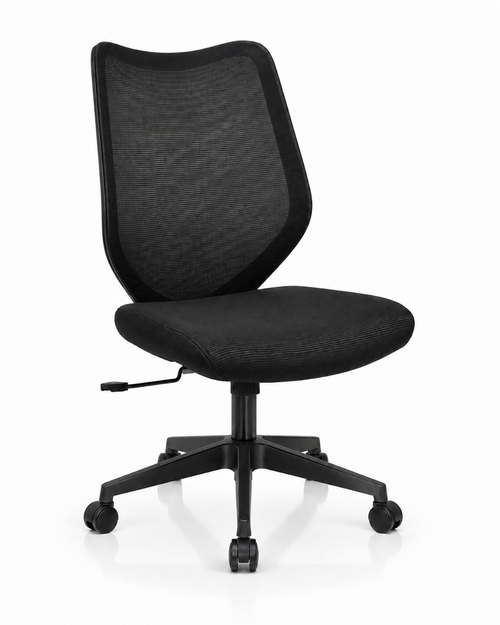
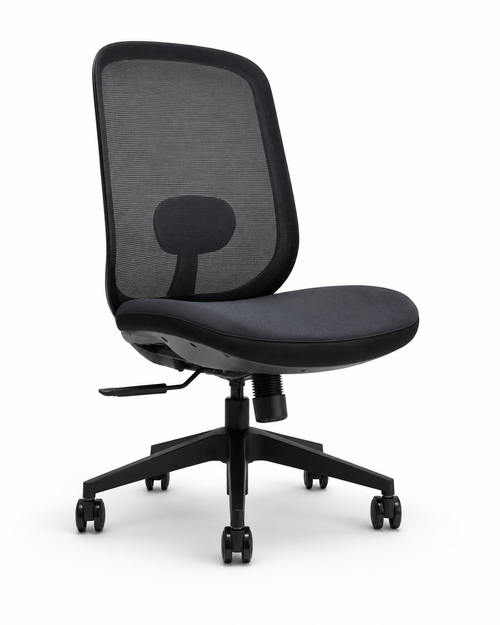
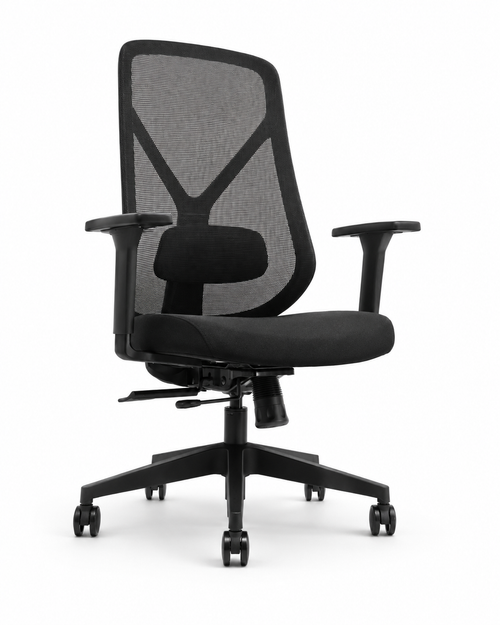
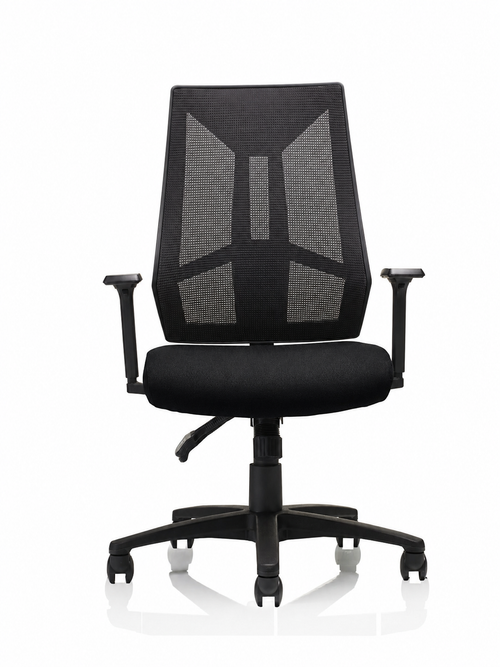
Mesh backs suit open-plan workstations and warmer climates — they offer better airflow and hold their shape well over years of daily use. Upholstered chairs suit boardrooms and client-facing spaces — softer, more premium-feeling, with a wider range of finishes. Most fitouts genuinely benefit from a mix of both rather than picking one for everything.
How does a mesh back chair perform?
A mesh back is a woven synthetic material stretched across a frame, rather than foam padding under fabric. The main advantage is airflow — mesh doesn't trap heat the way upholstery can, which matters in warmer climates, open-plan offices with a lot of bodies and equipment generating heat, or for anyone who runs warm through the day.
Mesh also tends to flex slightly with the body, offering a different kind of support than foam — some people find this more responsive, particularly through the lower back. Because there's less material and no foam to break down over time, mesh backs generally hold their shape well over years of daily use, provided the mesh itself is a commercial-grade weave rather than a lightweight consumer version.
The trade-off: mesh can feel firmer than upholstery to some users, and the visual style is more utilitarian — it reads as "task chair" rather than "boardroom chair," which matters if the seating is client-facing.
How do upholstered chairs perform?
Upholstered backs use foam padding under fabric, PU, or leather. The immediate benefit is a softer, more cushioned feel, and a broader range of finishes — colours, textures and materials that can match a boardroom or reception's design language in a way mesh generally can't.
Upholstery also tends to look and feel more "premium" out of the box, which is part of why boardroom and executive seating skews upholstered even when a mesh option would perform just as well functionally.
The trade-off is heat retention (foam and fabric hold warmth against the body) and long-term wear — foam compresses over years of use, and fabric can show wear patterns or staining in high-traffic environments faster than mesh does. Commercial-grade upholstery with a genuine warranty mitigates this, but it's worth asking directly about foam density and fabric grade rather than assuming all upholstery performs the same.
Which chair type suits which space?
A few practical patterns that tend to hold up across most commercial fitouts:
- Open-plan workstations, call centres, warehouse offices — mesh is usually the better fit. Airflow matters more in high-density seating, and the utilitarian look isn't a downside in a functional workspace.
- Boardrooms, executive offices, reception areas — upholstery generally wins on presentation, especially where the chair is part of how a client or visitor experiences the space.
- Mixed-use or budget-conscious fitouts — a hybrid approach works well: mesh for the bulk of workstation seating, upholstered for the handful of client-facing or leadership seats.
- Climate-sensitive environments — if the space runs warm (poor airflow, north-facing glass, high occupancy density), mesh is worth prioritising regardless of the room's function.
Does the material matter more than the frame and mechanism?
Whichever you choose, the material itself is only part of the equation. A commercial-grade mesh or upholstery on a poorly designed frame and mechanism won't outperform a well-built chair in the "wrong" material. Adjustability (lumbar support, seat depth, arm height), the quality of the tilt mechanism, and the AFRDI rating behind the chair all matter more to long-term comfort and durability than mesh-versus-fabric alone.
If you're speccing a mix of workstation and client-facing seating for the same fitout, it's worth talking through the full space rather than picking one material for everything — most workplaces genuinely benefit from both.
Corporate Chair Systems manufactures both mesh and upholstered commercial seating in Australia, across ergonomic, boardroom and reception ranges. Get in touch if you'd like help matching chairs to your specific spaces.